Nopestalgia scene notes · 1665
What's wrong in 1665? An Amsterdam canal harbor in the Dutch Golden Age
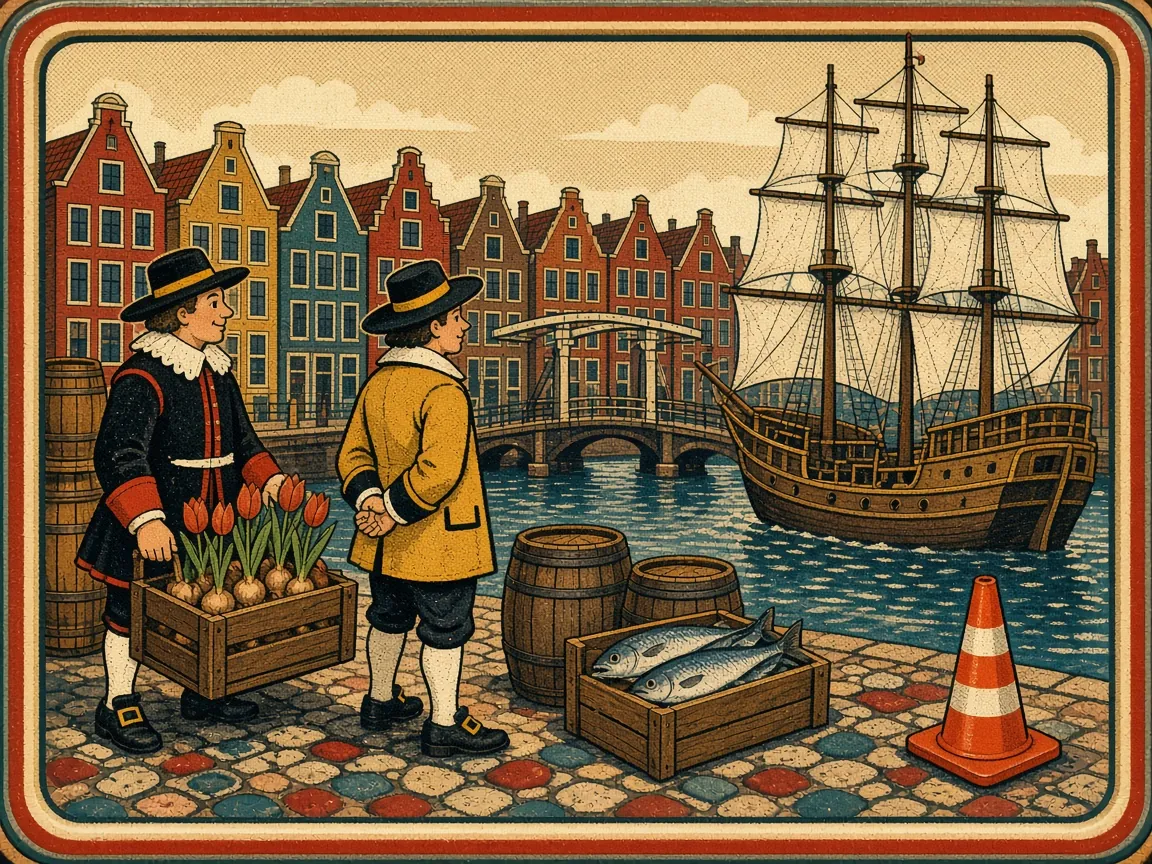
It is 1665 in Amsterdam, then one of the richest cities in the world. Two merchants in wide-brimmed hats and white collars inspect a crate of tulip bulbs on the cobbled quay. Barrels and a crate of fresh herring wait to be loaded, a tall three-masted ship rides at anchor, and a white wooden drawbridge spans the canal in front of a row of narrow, gabled canal houses.
This is the Dutch Golden Age. The Dutch East India Company dominated the spice trade, Dutch ships carried goods all over Europe, and the herring fishery was so important that people said Amsterdam was built on herring bones. 1665 was also the year the Second Anglo-Dutch War broke out, a naval war fought mostly over trade.
What belongs in 1665
Every Nopestalgia scene gets a period check before it goes live. Here's what's in this one, and why it fits the year:
- Gabled canal houses. Amsterdam's tall, narrow brick houses with step and bell gables were built along the canal ring during the 1600s. Narrow fronts kept property taxes down, and hoist beams at the top lifted goods to upper floors.
- Tulip bulbs. Tulips arrived in the Netherlands from the Ottoman Empire in the late 1500s, and the famous tulip-bulb price bubble peaked in 1637.
- Herring in a crate. Salted herring was a staple export, packed into barrels at sea.
- The sailing ship. Large square-rigged merchant ships like this one carried Dutch trade, with no steam engines or funnels anywhere.
- Clothes and hats. Wide-brimmed hats, dark doublets, breeches, white falling collars and buckled shoes all fit the mid-1600s.
What we kept out
No street lamps (Amsterdam got public oil street lighting in 1669, designed by Jan van der Heyden), no steamships, no bicycles, and no flags or signs with lettering. Only one thing in the picture is allowed to be out of place.
The answer
Show the hidden modern object (spoiler)
The modern object is an orange traffic cone. The traffic cone was patented by Los Angeles street painter Charles D. Scanlon in 1943 (applied 1941), and molded plastic cones followed in the 1950s and 60s.
Hint, if you just want a nudge: Something on the quay is a little too orange.
More scenes
← What's wrong in 1503? · What's wrong in 1776? → · All scenes