Nopestalgia scene notes · 1350
What's wrong in 1350? A medieval market square
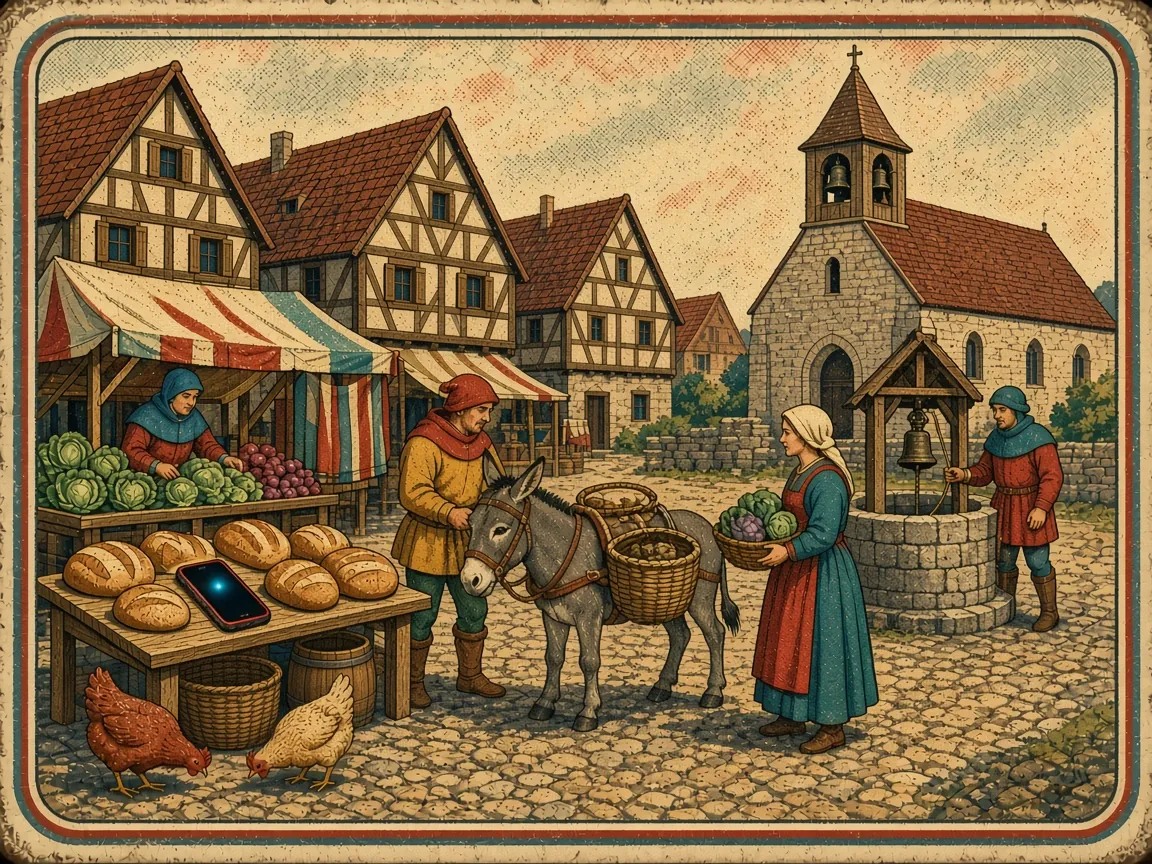
It is 1350 in a small market town somewhere in northern Europe. Traders have set up striped awnings in front of half-timbered houses, a woman bargains over cabbages, a man leads a donkey loaded with wicker panniers, and chickens peck at crumbs between the cobbles. Behind them stands a plain stone parish church with a little bell-cote, and in the middle of the square is the town well.
This is also one of the darkest years in European history. The Black Death reached Europe in 1347 and swept across the continent until about 1351, killing somewhere between a third and a half of the population. Markets like this one kept going anyway: towns still needed bread, and the shortage of workers after the plague would soon push wages up and loosen the old feudal order.
What belongs in 1350
Every Nopestalgia scene gets a period check before it goes live. Here's what's in this one, and why it fits the year:
- Half-timbered houses. Timber framing filled with wattle and daub was the standard way to build town houses in much of northern Europe. Window openings were usually closed with wooden shutters, because glass was expensive and mostly reserved for churches and the very rich.
- Bread on the stall. Bread was the core of the medieval diet, and bakers were closely regulated. In England, the Assize of Bread and Ale (from the 1260s) tied the weight and price of a loaf to the price of grain.
- Cabbages and grapes. Cabbages and other brassicas were everyday medieval vegetables. You will not find potatoes, tomatoes or maize anywhere here: those crops came from the Americas and only reached Europe after 1492.
- Hoods and tunics. Wool tunics, hose and hoods with shoulder capes were ordinary working clothes in the fourteenth century.
- The donkey and the well. Pack animals carried goods to market, and a shared well was the town's water supply long before pipes and pumps.
What we kept out
No printed signs (European movable-type printing arrived around 1450), no public clocks on the church (mechanical tower clocks were still rare and new), and no New World food. Only one thing in the picture is allowed to be out of place.
The answer
Show the hidden modern object (spoiler)
The modern object is a smartphone. The first touchscreen smartphone, IBM's Simon, went on sale in 1994; the modern slab smartphone took off after 2007.
Hint, if you just want a nudge: Bakers were busy people. Check the bread.
More scenes
← What's wrong in 1925? · What's wrong in 1503? → · All scenes